- Opened by
- Boats
- studio and screens
- Award on screen
- 7
- captured panel
- Listed as
- seven, nine or eleven
- outside listing
- On sale
- Two things
- captured panel
- Kept from base play
- Cascade and pearls
- studio and listing
OctoWins Pateplay · underwater slot
The bonus round in OctoWins is the base game with the stake removed: the same five reels of three, the same cascade, the same pearls landing and the same ladder climbing. What is worth a page of its own is not the mechanics — it is that three published accounts of this round give three different numbers for the same thing.
So this page does both jobs. It describes the round as the captured screens show it, and it sets the disagreement out in full rather than picking the figure that reads best.
Boats open it. The scatter in this game is a small purple tug, it is counted wherever it lands rather than read from the left, and the octopus wild will not stand in for it — so the round cannot be forced by a wild arriving in a convenient place. Beyond that, the sources part company. Pateplay's own written description of the feature names one threshold; the listing that reproduces the game's full specification names a lower one. A capture this site holds shows five boats on screen at once, which is above both and settles neither.
What all of them agree on is that the round opens at the end of the chain rather than in the middle of it. The cascades from the triggering spin run to a stop first; the award panel comes up afterwards. That ordering matters because the ladder has already climbed by then, and the round inherits a screen that has been worked on rather than a fresh one.
This is the part worth being careful about, and the reason is that a reader will meet all three numbers if they go looking.
The award panel on the capture this site holds — a stone-framed plate that comes up over the reels when the round is granted — reads 7. The purchase panel above sells a tile labelled with the same figure. Those are two sightings of the same number inside the game itself. Against that, the listing which reproduces the game's full specification says the count is drawn at random from seven, nine or eleven depending on how many boats arrived, which is consistent with the captures: 7 is the bottom of that set, and a capture of a minimum award would show exactly what this one shows. And against both of those, Pateplay's own written summary of the feature gives a figure larger than any of them, with a re-trigger adding more on top.
There is a reason to trust the first two over the third, and it is worth stating rather than asserting a winner. The studio's written feature descriptions for this game are visibly shared text rather than copy written for it: one of them, filed under the name of the scatter, describes the purchase button instead of the scatter, and another describes a control at a price the captured panel does not charge. Text that is wrong about one part of the game is not a safe source for a number about another part. The screens are not text — they are the game.
What this page therefore says is: the round is worth 7 spins where it has been seen, a listing puts that at the bottom of a set of seven, nine or eleven, and the count shown in the copy being played is the only thing that settles it for that copy. That is less tidy than one number and it is the honest shape of what is known.
Everything except the stake. A free spin lands fifteen symbols on the same grid, is read the same way from the left along neighbouring reels, and cascades the same way when something pays. The pearl multipliers keep landing — the studio is explicit that they are active in ordinary play and in the round alike — and the ladder keeps climbing with each refill.
The wild keeps its rule too, which is more interesting here than it sounds. Because the octopus only arrives after a cascade has paid, a free spin that opens with nothing on it stays without a wild, exactly as a paid spin would. The round does not quietly relax the game's own constraints to feel more generous; it is the same machine with the meter switched off.
What is lost is the stake and, with it, the toggle. A priced side bet has nothing to attach to on a spin that costs nothing, and no capture shows it active during the round. If the toggle was set when the triggering spin was paid for, it was paid for then.
There is one more thing the round inherits that is easy to miss. The ladder does not reset when the round opens. The cascades of the triggering spin have already moved it, and the first free spin starts from wherever they left it rather than from the bottom of the chain — which is why a round opened by a long chain is worth more than the same number of spins opened by a short one. Nothing in the published descriptions says this in so many words; it follows from the ordering, which every source agrees on: the chain finishes first, the award panel comes up afterwards.
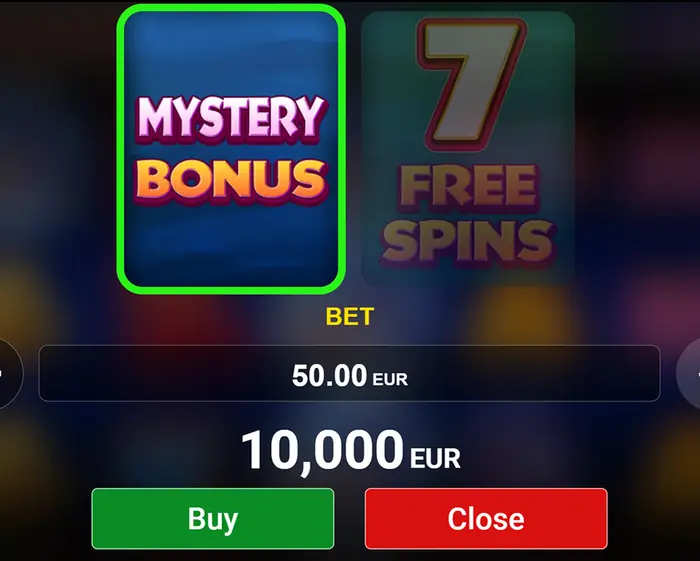
Pressing the purchase button brings up the panel in the picture above. Two tiles sit across the top; a stake selector sits under them with a minus and a plus; a single price sits under that; and two buttons, one green and one red, finish it. Selecting a tile outlines it in green, and the price belongs to the selection.
One tile is the free spins and names its own count. The other is labelled as a mystery purchase, and the listing that reproduces the game's specification mentions a mystery cash feature alongside the jackpot — which is almost certainly the same thing under its catalogue name, though "almost certainly" is as far as that can honestly be taken from the outside. What a mystery purchase buys by definition is an outcome drawn at the moment of buying rather than a named round, so there is nothing further to describe about it that would not be invention.
The price is the other thing this page declines to print as a number. On the capture, a stake of 50.00 carries a price of 10,000 with the mystery tile selected, which is two hundred times the stake. Pateplay's own written description of buying the free-spins round gives half that multiple. Those two figures can both be true — they are attached to different tiles — but nothing available from outside the game proves which price goes with which tile, so neither multiple is printed here as the cost of anything. The panel shows the price against the stake before the green button is pressed, and that is the only figure a reader should act on.
A purchase of this kind is not free money and is not a discount. It is a trade: paying a fixed multiple of the stake now in exchange for an outcome that would otherwise have arrived on its own after an unknown number of spins. Whether that trade is good or bad in any particular session is not something anybody can say in advance, and any page that implies otherwise is selling something.
Two honest things can be said about it. The first is that buying removes the part of the game most people find tedious and keeps the part they came for, which is a real benefit and is why the button exists. The second is that it compresses the spending. A round bought at a large multiple of the stake is the same money as a long run of ordinary spins, handed over in one press instead of over twenty minutes, and the twenty minutes were doing something useful — they were the thing that made the amount feel like what it was.
A demo of this game exists. The studio's own record of it carries a demo identifier; two of the listings that cover the title offer a free round, one of them stating that it loads with no sign-up at all. None of the sources checked for this game says the demo is unavailable, which is worth noting because across the slots this network covers that happens often enough to be the rule rather than the exception.
There is no demo on this site, no window pretending to be one, and no link dressed up as one. The one button here that leaves the site goes to an operator, says so, and asks an age question before it opens. If a free round is what a reader wants, it is a thing the venues provide and not a thing this site can hand over.
Each answer below is the one carried in this page's structured data, word for word.
Boats. Enough of them anywhere on the screen and the round opens on the spot, without the octopus being able to help, because the octopus does not substitute for a boat.
The captured award panel shows 7, and the purchase panel sells 7. A listing of the game says the count is drawn from seven, nine or eleven, and the studio's own written summary gives a larger figure again.
Three published accounts, three answers. The panel inside the copy being played is the one that settles it.
The cascade and the pearls. A free spin is read exactly the way a paid one is; the only thing taken away is the stake.
Yes. A panel opens with two things on it, a stake selector and a price that moves with the stake. One of the two is the free spins; the other is a mystery purchase.
There is no single answer and this page does not invent one. The price is shown on the panel against the stake selected, and the studio's written figure and the captured panel do not agree.
No. The toggle adds half the stake again to every spin and improves the chance of the round arriving by itself. The purchase pays once and opens one immediately.